Note
Go to the end to download the full example code.
Matching known class shares after deployment
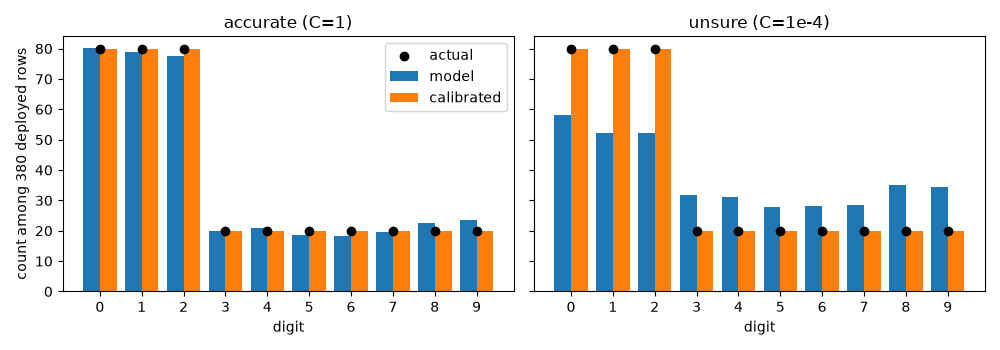
A classifier trained where every digit is equally common is deployed where 0, 1 and 2 are four times as common as the rest, and the new shares are known. Calibration makes each class’s predicted total equal its known share while keeping the order of rows within each class.
The standard fix for this kind of shift rescales each class probability by new share / training share and renormalizes each row (Saerens et al., 2002). It gives the better log loss here, for both an accurate and an unsure model. It does not force the predicted totals to equal the known ones (the unsure model’s land at 266 against 240), and because each row is renormalized separately it reverses the order of many rows within a class. Rank-preserving calibration does both exactly, at some cost in log loss. Reach for it when the totals must match, such as when probabilities feed an allocation or quota, and the ranking within each class is what decisions use.
Two models, one deployment
import matplotlib.pyplot as plt
import numpy as np
from sklearn.datasets import load_digits
from sklearn.linear_model import LogisticRegression
from sklearn.metrics import log_loss
from sklearn.model_selection import train_test_split

from rank_preserving_calibration import calibrate

X, y = load_digits(return_X_y=True)
X_train, X_pool, y_train, y_pool = train_test_split(
    X, y, test_size=0.5, stratify=y, random_state=0
)
rng = np.random.default_rng(0)
counts = np.where(np.arange(10) <= 2, 80, 20)
deploy = np.concatenate(
    [
        rng.choice(np.flatnonzero(y_pool == k), n, replace=False)
        for k, n in enumerate(counts)
    ]
)
X_test, y_test = X_pool[deploy], y_pool[deploy]

shares = counts / counts.sum()
M = shares * len(y_test)  # expected count per class; must sum to the row count

models = {
    "accurate (C=1)": LogisticRegression(C=1.0, max_iter=5000),
    "unsure (C=1e-4)": LogisticRegression(C=1e-4, max_iter=5000),
}
Log loss, totals and order
reorders counts adjacent pairs, within each class, whose order the
prior-ratio fix reverses; rank-preserving calibration reverses none.
def reorders(before, after):
    total = 0
    for k in range(before.shape[1]):
        column = after[np.argsort(before[:, k], kind="stable"), k]
        total += int((np.diff(column) < -1e-12).sum())
    return total


print(
    f"{'model':<16} {'raw':>6} {'ratio':>6} {'calib':>6} {'reorders':>9}"
    f"   total for 0-2 (actual {counts[:3].sum()})"
)
calibrated = {}
for name, model in models.items():
    P = model.fit(X_train, y_train).predict_proba(X_test)
    R = P * shares / np.bincount(y_train, minlength=10) * len(y_train)
    R /= R.sum(axis=1, keepdims=True)
    result = calibrate(P, M)
    calibrated[name] = (P, result.Q)
    print(
        f"{name:<16} {log_loss(y_test, P):6.3f} {log_loss(y_test, R):6.3f} "
        f"{log_loss(y_test, result.Q):6.3f} {reorders(P, R):9d}   "
        f"{P[:, :3].sum():.0f} raw, {R[:, :3].sum():.0f} ratio, "
        f"{result.Q[:, :3].sum():.0f} calibrated"
    )
model               raw  ratio  calib  reorders   total for 0-2 (actual 240)
accurate (C=1)    0.139  0.133  0.160       837   236 raw, 240 ratio, 240 calibrated
unsure (C=1e-4)   0.853  0.764  0.792      1781   163 raw, 266 ratio, 240 calibrated
Predicted against actual class counts
actual = np.bincount(y_test, minlength=10)
digits = np.arange(10)
fig, axes = plt.subplots(1, 2, figsize=(10, 3.5), sharey=True)
for ax, (name, (P, Q)) in zip(axes, calibrated.items(), strict=True):
    ax.bar(digits - 0.2, P.sum(axis=0), width=0.4, label="model")
    ax.bar(digits + 0.2, Q.sum(axis=0), width=0.4, label="calibrated")
    ax.scatter(digits, actual, color="black", zorder=3, label="actual")
    ax.set_title(name)
    ax.set_xticks(digits)
    ax.set_xlabel("digit")
axes[0].set_ylabel(f"count among {len(y_test)} deployed rows")
axes[0].legend()
fig.tight_layout()
plt.show()
Total running time of the script: (0 minutes 2.388 seconds)